Spark Network: How Bitcoin Stablecoins and Instant Payments Work
Spark brings bitcoin and stablecoins to instant payments without channels. Understand statechains, operators, unilateral exits, Lightning integration, and the real risks.
There is an odd gap in the crypto market. Bitcoin is the industry's most established settlement network, yet people who want digital dollars usually move to Ethereum, Tron, Solana, or another chain.
Bitcoin historically lacked a practical environment for transferring stablecoins. Spark addresses that gap by supporting instant bitcoin and token transfers in one self-custodial wallet, without requiring users to open payment channels.
This guide explains Spark through real-world analogies. No previous technical knowledge is required.
First, there are two unrelated projects named Spark
| Name | What it is |
|---|---|
| Spark for Bitcoin | The payment network covered here, developed by Lightspark. Official site: <a href="https://www.spark.money/">spark.money</a> |
| Spark in the Ethereum ecosystem | An unrelated lending and yield protocol |
This article covers the Bitcoin payment network being integrated with Depix.Online.
In one sentence
<strong>Spark transfers value by changing who can spend a stationary Bitcoin output rather than moving that output for every payment.</strong>
That inversion is what makes internal transfers fast and inexpensive.
The problem Spark solves
The Bitcoin whitepaper describes peer-to-peer digital cash, but Bitcoin's base layer intentionally sacrifices throughput for security and independent verification. Our scalability-trilemma guide explains why.
Lightning makes daily bitcoin payments practical but introduces channels, inbound liquidity, and monitoring requirements. It also originated as a bitcoin payment system rather than a general token platform.
Lightspark introduced Spark as an open protocol for self-custodial bitcoin and token payments with Lightning interoperability.
Its intended user experience includes:
- Instant internal transfers.
- No payment channels or inbound-liquidity setup for the end user.
- Self-custodial key ownership.
- Native support for issued assets such as stablecoins.
- Lightning sending and receiving through service providers.
- No required Bitcoin consensus change.
Spark is not trustless in the same sense as a plain Bitcoin output. Operators participate in a transfer, and understanding that assumption is essential.
The two-lock vault analogy
A vault with two locks
Imagine a vault that requires two parts of a key to open.
- You control one key share.
- A group of independent operators collectively controls the other share.
The bitcoin remains in the same on-chain output while it is used inside Spark.
The counterintuitive part
When you pay someone, the protocol does not need to publish an ordinary Bitcoin transaction moving the vault's coins.
- The operators complete a protocol that invalidates their previous signing shares associated with you.
- New signing shares are created for the recipient.
- The on-chain output remains where it was, but control has been handed to the recipient.
   BEFORE                         AFTER

   ┌─────────┐                    ┌─────────┐
   │  VAULT  │  the money does    │  VAULT  │
   │  $500   │  not move          │  $500   │
   └────┬────┘                    └────┬────┘
        │                              │
   your share + operators        Maria's share + operators

        spending control changed, not the Bitcoin output
This family of constructions is known as a statechain. The concept predates Spark; Spark packages statechain-style handoffs into a production-oriented payment protocol.
Why the handoff can be secure
The primary transfer risk is that old operator shares might be retained and used with the previous owner to create a conflicting spend.
Spark uses a one-honest-operator assumption for the handoff: if at least one required operator honestly deletes its obsolete share, the old signing configuration cannot be reconstructed in the expected way.
That is commonly described as a “1-of-n honest” model. Its real strength depends on operator independence, implementation details, and the size and composition of the active operator set.
Who the operators are
Spark Operators collectively maintain the operator side of threshold-controlled outputs. No single operator should hold the complete operator key.
The protocol uses threshold Schnorr techniques based on FROST—Flexible Round-Optimized Schnorr Threshold signatures—to generate signatures collectively without assembling a full private key on one machine.
Operator-set size matters
The security slogan “one honest operator is enough” is only as meaningful as the independence and diversity of the set. A small set offers less organizational fault tolerance than a large, geographically and economically independent one.
The active operator configuration is a time-sensitive fact. Users considering meaningful balances should verify it in the current Spark documentation and FAQ rather than rely on an old launch number.
The role of an SSP
A Spark Service Provider, or SSP, supplies liquidity and coordinates user-facing operations such as cooperative deposits, withdrawals, and Lightning swaps.
An SSP is not supposed to hold the user's Spark balance. Multiple SSPs can exist, reducing dependence on one provider for normal liquidity routes. The unilateral path remains the fallback when cooperative service is unavailable.
The important detail: transfer trust is time-bounded
A custodial exchange creates continuous counterparty exposure for as long as the balance remains there. Spark's operator assumption is concentrated around a key handoff.
During transfer, the recipient depends on the required operators correctly rotating and deleting old shares. Once the new ownership state is established, the previous owner no longer has the expected signing configuration.
| Custodial exchange | Spark | |
|---|---|---|
| When the trust exposure exists | Continuously while the balance is held | During ownership handoff and supported service flows |
| Who controls the customer key | The custodian | The user keeps a required key share |
| If the service disappears | Withdrawal depends on the custodian | A unilateral exit is available under its protocol conditions |
This is a narrower trust model than custody, but it should not be oversimplified into “no trust.” Software integrity, backups, operator behavior during handoff, and exit readiness still matter.
What operators can and cannot normally do
| Operators cannot do alone | Operators can do operationally |
|---|---|
| Spend with only the operator-side shares | Refuse or fail to process a transfer |
| Reconstruct the user's complete signing authority | Become unavailable and force users toward recovery paths |
Leaving without permission
Like Ark, Spark is meaningfully self-custodial only if a user can exit without a service approving the withdrawal.
Spark supplies pre-signed transaction material that lets the user recover value to the Bitcoin base layer. Lightspark described the production release of this mechanism in its unilateral-exit announcement.
Think of the recovery transaction as an enforceable document prepared before trouble occurs. If cooperative services disappear, the user can publish the required transaction chain rather than ask for permission.
Two exit routes
| Route | How it works | Trade-off |
|---|---|---|
| Cooperative | An SSP provides liquidity through an atomic swap or supported withdrawal | Faster and usually cheaper, but depends on available service |
| Unilateral | The user publishes the pre-signed recovery path | Slower, more technical, and subject to Bitcoin fees and timelocks |
The honest warning
A unilateral exit is not equivalent to a one-click exchange withdrawal. It can require multiple steps, preserved parent transactions, ordinary on-chain bitcoin for fees, and waiting for relative timelocks.
Community projects such as the Blink Spark unilateral-exit tooling exist because operational recovery deserves its own workflow.
Treat unilateral exit like a fire extinguisher: know where it is, keep it usable, and test with a small amount before an emergency.
Small change or large banknotes
A Spark wallet balance is represented by multiple leaves rather than one database number. Those leaves resemble banknotes of different denominations.
| Balance shape | Advantage | Disadvantage |
|---|---|---|
| Many small leaves | Easier to compose exact payments | A unilateral exit may require more transaction data and fees |
| Fewer large leaves | A simpler exit path | A payment may require splitting or restructuring first |
Wallet software can optimize leaf selection and consolidation. If a user expects to rely on an emergency exit, preparing the balance while cooperative services still operate can reduce recovery cost.
Lightning interoperability
Spark connects to the Lightning Network through atomic swap flows coordinated by service providers.
A Spark user can pay a standard Lightning invoice or receive from a Lightning wallet without managing channels directly. The user sees a normal payment flow while the service handles the conversion between Spark ownership and Lightning liquidity.
The swap should be atomic: either both sides complete or neither side does, preventing one party from losing value halfway through the conversion.
This interoperability does not make Spark itself a Lightning channel network. It makes Lightning reachable from a different balance architecture.
Stablecoins on Bitcoin infrastructure
Spark's token model is the main reason the protocol matters to stablecoin platforms. Its official stablecoin overview describes issued assets that can move with Spark's low-latency payment model.
The intended benefits are:
- Sub-second internal settlement without waiting for a Bitcoin block.
- No gas market for transfers inside the network.
- Bitcoin-based enforcement rather than an unrelated smart-contract chain.
- Bitcoin and stablecoin balances in the same wallet experience.
- Issuance APIs that avoid deploying general-purpose smart contracts.
Assets and integrations
Stablecoin support and wallet integrations change quickly. Spark publicly presents token issuance and an ecosystem of wallets and infrastructure providers on its official ecosystem page.
Issuer, reserve, redemption, and regulatory risk remain properties of each stablecoin. Running on Bitcoin-related infrastructure does not make an issuer-backed asset equivalent to bitcoin.
Spark, Ark, and Lightning compared
| Lightning | Ark | Spark | |
|---|---|---|---|
| Core model | Bilateral channels | Shared UTXOs and VTXOs | Threshold-controlled statechain leaves |
| User opens a channel? | Yes, directly or through managed infrastructure | No | No |
| Inbound liquidity needed? | Yes | No user channel liquidity | No user channel liquidity |
| Must remain online? | Monitoring is required | Not merely to receive | Not merely to receive |
| Does the balance expire? | Channel state has contest windows, not balance expiry | VTXOs expire | Leaves use recovery timelocks, not Ark-style recurring expiry |
| Unilateral exit? | Yes | Yes | Yes |
| Native token focus | Bitcoin payments | Implementation-dependent asset support | Bitcoin and issued assets |
| Production maturity | Most mature | Newer | Newer |
Lightning has the deepest production history and strongest channel ecosystem. Ark removes channels through shared transaction trees but introduces expiring VTXOs. Spark enables key handoffs and token transfers but depends on operator behavior during those handoffs.
None replaces every other system.
What Spark does not solve
1. Operator concentration. A one-honest-operator model benefits from a large, genuinely independent set. Users should check the current deployment rather than assume decentralization from the protocol name.
2. Unilateral exit is a procedure. Recovery requires preparation, fee liquidity, correct backups, and several protocol steps. Independent analysis, including spark.exposed, highlights the difference between the simple headline and the operational process.
3. Applications can impose their own rules. Protocol-level exit guarantees do not prevent a wallet provider from applying interface limits, compliance controls, or service policies. Separate protocol guarantees from application policy.
4. Privacy is limited. Users prioritizing confidential amounts should compare Spark with Liquid's Confidential Transactions.
5. It is young technology. Documentation, operator topology, limits, and wallet behavior can change. Use conservative amounts and verify current conditions.
6. It is still a bridge, not a vault. Money intended to remain untouched for years belongs on Bitcoin's base layer under a recovery plan the owner controls.
Technical details
The canonical starting point is the Spark documentation.
- A leaf is controlled through threshold signing material split between the user and Spark Entity operators.
- Spark Operators collectively form the operator side of the protocol; an SSP supplies user-facing liquidity and swap services.
- FROST allows participants to produce Schnorr signatures without reconstructing a complete private key on one node.
- A transfer rotates signing shares from the old owner to the new owner. Security requires enough operators to delete obsolete shares according to the active threshold configuration.
- Balances contain terminal leaves with recovery timelocks and non-terminal branch structures used for splitting and combining value.
- Unilateral recovery uses pre-signed transactions and timelocks prepared as part of the deposit or leaf construction.
- Cooperative withdrawal and Lightning interoperability use atomic swaps with an SSP.
- The protocol does not require a new Bitcoin opcode or consensus fork.
Spark at Depix.Online
Depix.Online is integrating Spark because it offers a direct route for fast bitcoin and stablecoin settlement on Bitcoin-oriented infrastructure.
What changes:
- Near-instant settlement for supported deposits and withdrawals.
- No payment-channel setup for the customer.
- Bitcoin and issued assets can share a wallet experience.
- Lightning becomes reachable without exposing channel operations to the user.
What remains the same:
- Depix.Online does not keep customer balances.
- There is no traditional account or wallet connection. Identity is verified once through the R$1 PIX flow, and the approved CPF or CNPJ is reused for orders.
- Purchased value goes directly to the wallet address supplied by the customer.
DePix continues to be issued on the Liquid Network, where transaction amounts and asset types are confidential by default. Ark and Spark expand settlement routes; they do not silently change the network on which DePix is issued.
Glossary
| Term | Plain-English meaning |
|---|---|
| Layer 2 | A protocol built above Bitcoin to make frequent payments faster or cheaper |
| Stablecoin | A digital asset intended to track a fiat currency such as the dollar or real |
| Statechain | A construction that transfers control of a stationary Bitcoin output |
| Spark Operator | A participant holding part of the operator-side signing material |
| FROST | A protocol for producing threshold Schnorr signatures |
| One honest operator | The assumption that at least one required operator correctly deletes obsolete key material |
| SSP | A service provider supplying deposits, withdrawals, and Lightning swap liquidity |
| Leaf | One spendable component of a Spark wallet balance |
| Unilateral exit | Recovering value on-chain without service-provider permission |
| Self-custody | The user controls indispensable keys and an enforceable recovery path |
Conclusion
Spark turns a long-discussed Bitcoin idea—transferring signing control rather than publishing a new on-chain spend for every payment—into infrastructure for bitcoin, stablecoins, and Lightning-connected wallets.
Its most valuable property is that the handoff trust assumption is narrower than permanent custody. Its limitations are equally real: operator concentration matters, unilateral exit is an operational procedure, application policies can differ from protocol guarantees, and the technology has a short production history.
Those facts do not disqualify Spark. They define its proper use.
Spark can move money extremely well. It should not be mistaken for long-term cold storage.
Like every payment layer above Bitcoin, it is a bridge rather than a vault.
Related articles
- Bitcoin Layer 2s and the Scalability Trilemma
- Ark Network: What It Is and How It Works
- Liquid Network for Beginners
- What Is DePix? A Guide to Brazil's Real Stablecoin
Official sources
- Spark official website
- Spark documentation
- Spark core concepts
- Spark FAQ
- Statechains technical overview
- Stablecoin issuance on Bitcoin
- Lightspark's Spark announcement
- Lightspark's unilateral-exit announcement
- Community unilateral-exit tooling
This content is educational and informational and does not constitute financial, legal or investment advice. Digital assets involve risk.
Related articles
Ark Network: What It Is and How Bitcoin's Layer 2 Works
Ark is a Bitcoin layer that lets anyone receive instant payments without opening channels, locking up liquidity, or giving up their keys. A plain-language guide to VTXOs, rounds, unilateral exits, Arkade, and Bark.
Bitcoin Layer 2s: Why They Are Bridges, Not Vaults
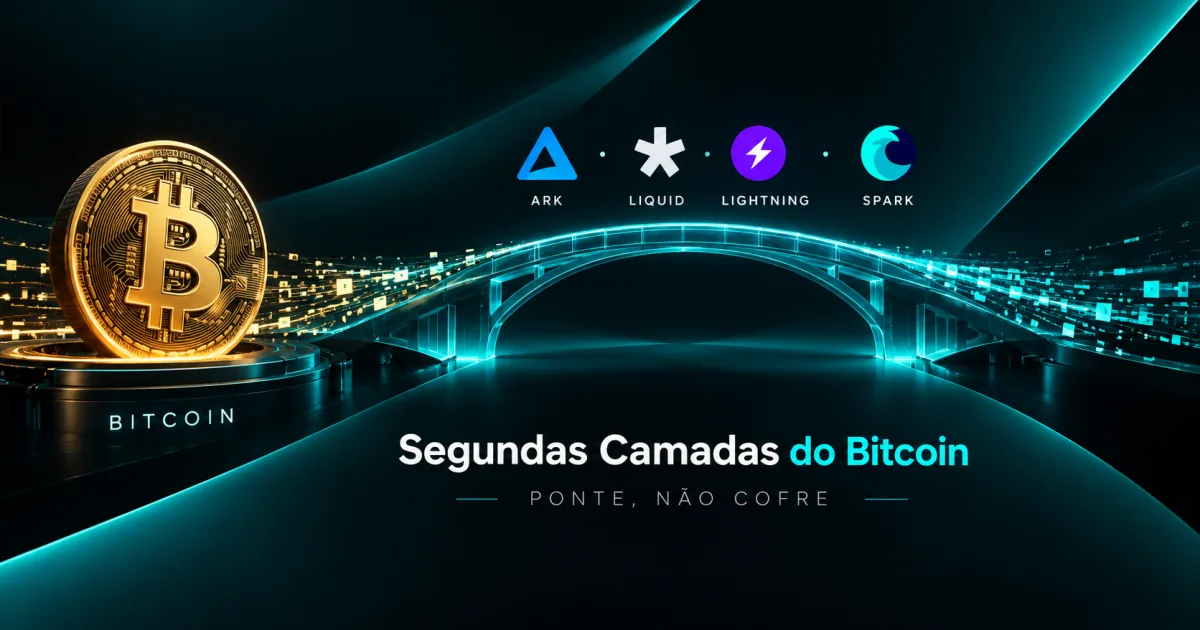
The scalability trilemma explains why Bitcoin's base layer is deliberately limited. Understand Lightning, Liquid, Ark, and Spark—and why payment layers are not designed for long-term savings.